Background
Muay Thai history in brief
From the battlefield art of Siam to the ring, the rope-bound fists, the royal tournaments and the gloves: a short, sourced history of Muay Thai.
Choose your seat for fight night ↗From muay to Muay Thai
For most of its history the sport was simply called muay. The name Muay Thai, Siamese boxing in English, came into use in the early twentieth century, when physical education documents needed to tell it apart from international boxing, which Thais call muay sakon. The older, pre-modern forms are now grouped under the name muay boran, ancient boxing. Muay Thai sits in a family of related arts across the region, and its professional league today is governed by the Professional Boxing Association of Thailand and sanctioned by the Sports Authority of Thailand.
A soldier's art
Muay Thai's roots are military. By the traditional account it was developed by the Siamese army as a form of self-defence, and a war-strategy manual attributed to King Ram Khamhaeng dates it back at least to the thirteenth century. Fighters were later recruited into the king's guard, and in the Ayutthaya period the best boxers served in a royal unarmed guard division. Before gloves, fighters bound their hands and forearms in rope, which protected the fists and made their blows more likely to cut.
Kings and temple fairs
Fights were also entertainment. The royal chronicles of Ayutthaya record that in 1702 King Suriyenthrathibodi disguised himself as a commoner, went by boat to a temple fair and won two boxing matches there. Matches at festivals became part of Thai life, with fighters from different regions testing their styles against one another. The best known of the old stories, that of Nai Khanom Tom defeating ten Burmese boxers in 1767, is celebrated each year on 17 March as Muay Thai Day, although several scholars regard it as a modern legend rather than documented history.
Royal patronage
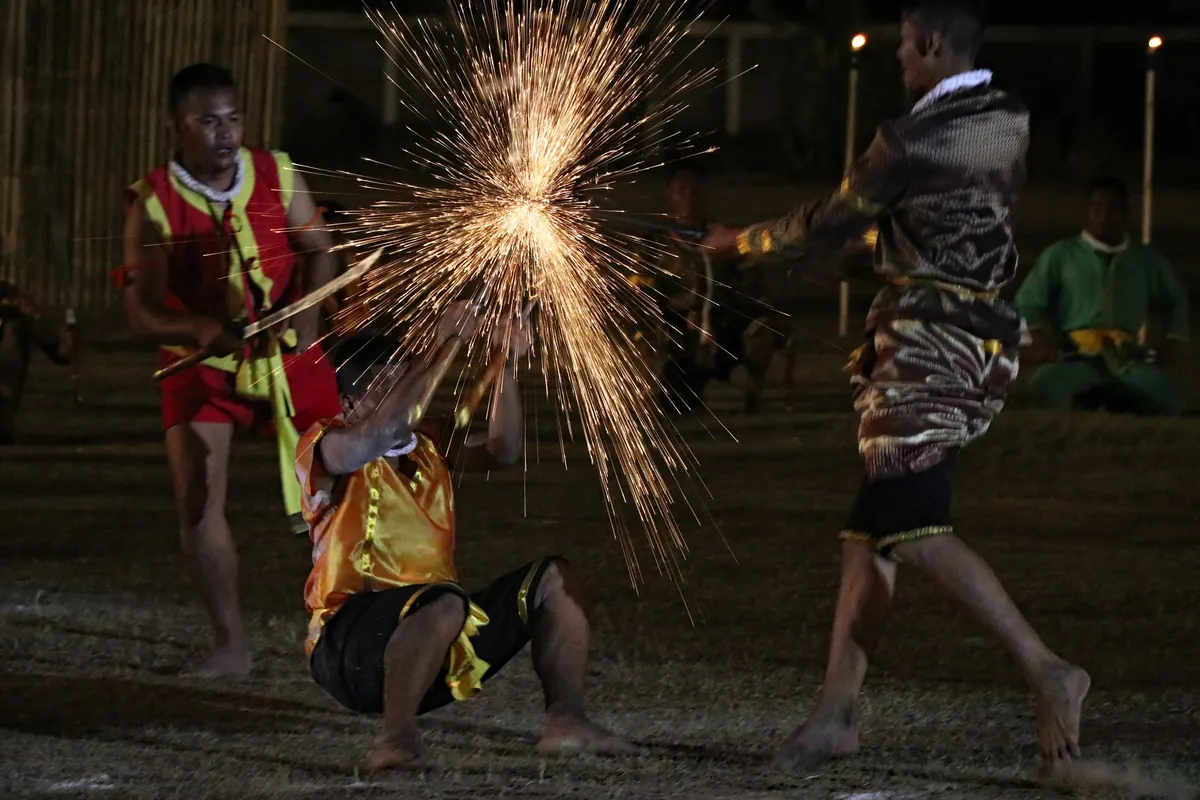
The reign of King Chulalongkorn, Rama V, which began in 1868, is remembered as a golden age for the sport. He held tournaments across the country and set up a royal boxing centre to train fighters in both Muay Thai and krabi krabong. In 1887 the department he founded put Muay Thai into the national curriculum for physical education teachers and the royal military academy. In 1910 fighters from Lopburi, Khorat and Chaiya were honoured at a royal funeral, and their styles later became recognised regional schools of muay boran.
Rings, rules and gloves
The modern sport took shape in the twentieth century. In 1921 Suan Kulap College put up Siam's first permanent ring, used for muay and for British boxing alike, and two years later the Suan Sanuk Stadium brought in a three-rope, international-style ring with padded red and blue corners. Under King Rama VII the rules were codified, with referees and timed rounds. Rope-bound hands survived in fights between Thais until a death in the ring led to gloves and foot coverings becoming the rule. The older style, now called muay boran, lives on mainly as an exhibition art.
The southern connection
One of the regional styles honoured in 1910 came from the south. Muay Chaiya developed in Chaiya District of Surat Thani province, which borders Takua Pa district, where most of Khao Lak lies. It was famous in the reigns of Rama V and Rama VI, and its techniques were said to work even against heavier opponents. You will not see a labelled Chaiya bout at a modern card, but the region has been part of Thai boxing history for more than a century.
Going global
Inside Thailand, the sport's peak of popularity came in the 1980s and 1990s. Abroad, practitioners from Thailand began competing in kickboxing and mixed-rules matches, and the international amateur body, IFMA, was founded in 1993. Muaythai, as international bodies now write it, featured at The World Games in 2017, and on 20 July 2021 the International Olympic Committee granted IFMA full recognition. The ritual, the rounds and the eight weapons you see at a Khao Lak card all come from this long history.
Read next: The wai khru ram muay explained
Sources